Ronnie Coleman is one of the most dominant bodybuilders in the history of the sport. Known as “The King,” he won eight consecutive Mr. Olympia titles from 1998 through 2005, tying the all-time record and becoming the standard many lifters still associate with extreme mass, conditioning, and strength.
His story also has a practical, almost unlikely beginning. Coleman was born in Monroe, Louisiana, played football at Grambling State, studied accounting, and later became a police officer in Arlington, Texas. Bodybuilding was not the original plan. His path changed when he started training at MetroFlex Gym, where Brian Dobson saw his potential and encouraged him to compete.
That mix is part of why the Ronnie Coleman workout routine still gets searched. It was not only a bodybuilding split. It was a routine shaped by heavy basic lifts, long-term repetition, a demanding gym environment, and the discipline of someone balancing elite training with real work outside the gym.
Coleman’s best-known training footage is also why his routine needs careful context. The lifts were enormous, the volume was high, and the intensity was far beyond what most lifters can recover from. This guide keeps the useful lessons while scaling the routine into something a serious recreational lifter can actually run.
Ronnie Coleman’s training still matters because it sits between two worlds: bodybuilding and strength training. He did not build his physique only with light pump work. He used squats, deadlifts, bench presses, barbell rows, military presses, leg presses, and other heavy compound lifts as the foundation for high-volume bodybuilding sessions.
That approach is often called powerbuilding today. The idea is simple: use big lifts to build strength and dense muscle, then use bodybuilding work to add volume, shape, and weaker-muscle attention.
The risk is copying the most extreme version too literally. A professional bodybuilder with years of adaptation, specific recovery habits, and an unusual tolerance for workload is not a normal baseline. Most lifters should learn from the principles, not copy every set.
The practical lesson is this: lift hard, keep the big exercises in the plan, track progression, and respect recovery. If the logbook is improving and your joints feel stable, the plan is working. If performance drops and fatigue stacks up, the routine needs less volume before it needs more motivation.
The Ronnie Coleman workout routine is a high-volume powerbuilding split built around heavy compound lifts, repeated weekly body-part work, and enough accessory volume to train each muscle from multiple angles.
Use Coleman as a powerbuilding case study: heavy basics first, enough accessory work to build muscle, and enough restraint to keep the logbook moving.
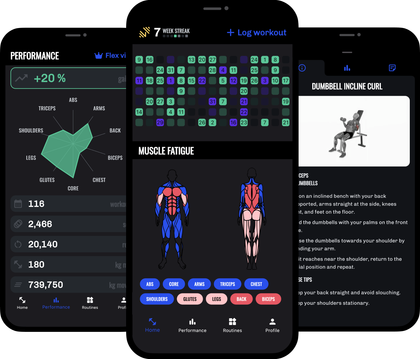
Track sets, reps, weight, rest times, RPE/RIR, and progress with Legend, on iOS and Android.
Coleman-style training needs maturity. If a lift gets heavier while form stays clean, the program is doing something useful. If every session turns into a battle to survive the volume, the routine is too large for your current recovery.
Powerbuilding is a training style that combines strength-focused compound lifts with bodybuilding-focused volume. A pure powerlifting plan is mostly judged by performance in the squat, bench press, and deadlift. A pure bodybuilding plan is judged by physique outcomes. Powerbuilding uses both ideas.
In a Coleman-inspired plan, that usually means:
The useful part is not just lifting heavy. It is putting heavy work in a repeatable structure. If your heavy lifts are chaotic and your accessory work is random, the routine becomes hard to measure. Coleman-style training works best when the main lifts, rep ranges, and progression targets stay visible.
Ronnie’s signature lifts are not obscure. They are the heavy basics that make a barbell plate calculator, a logbook, and honest recovery decisions matter: deadlifts, squats, presses, rows, pulldowns, leg presses, and direct arm and shoulder work.
Before jumping into the routines, it helps to understand the exercises that made the style work. Most are simple. They can be loaded, repeated, and tracked over years.
Coleman’s back training is hard to separate from the deadlift. In a practical routine, the deadlift is not there for ego. It is there because it loads the posterior chain, traps, lats, spinal erectors, grip, and trunk with one measurable movement.
Use it early in the session, warm up gradually, and stop the set when your position breaks. High-rep deadlifts are demanding. You do not need to copy the most extreme footage to benefit from the lift.
Barbell Deadlift
The squat is the lower-body anchor. Coleman was famous for pushing squats hard, but the lesson for most lifters is more basic: keep a heavy knee-dominant compound lift in the plan and progress it over time.
Use a depth and stance you can repeat. If your hips shift, your lower back takes over, or your reps become inconsistent, the load is too high for the goal.
Barbell Squat
The bench press gives the chest a heavy, trackable main lift. Coleman-style chest training often includes multiple pressing angles, but the flat barbell bench remains the simplest place to measure strength.
Treat it as a chest builder, not only a number. Keep your shoulder blades stable, lower the bar under control, and add load only when the reps stay consistent.
Barbell Bench Press
Rows are central to the Coleman look because his back training needed both thickness and width. The barbell row lets you load the upper back, lats, traps, rear delts, and trunk while still tracking progression clearly.
The tradeoff is fatigue. If your row becomes a standing hip thrust, use less weight or switch to a chest-supported row for that phase.
Barbell Bent-Over Row
The leg press and hack squat let you keep loading the quads after squats without the same balance demand. In the classic Coleman routine, leg work was not minimal. The second and third lower-body movements made the session brutal.
For most lifters, pick one of these after squats. You rarely need both at full volume in the same practical session.
Machine Leg Press
Coleman’s back days often separated thickness and width. Pulldowns and pull-ups cover the width side. They also let you train the lats hard without loading the spine the same way deadlifts and bent-over rows do.
If bodyweight pull-ups are not ready yet, pulldowns are a good substitute. Track the weight, reps, and control rather than turning each set into loose momentum.
Cable Lat Pull-Down
Coleman trained shoulders with heavy presses, but lateral raises still matter because side delts make the upper body look wider. This is not the exercise to turn into a max-effort lift.
Use controlled reps, modest load, and a clear top position. If the traps take over every rep, reduce the weight.
Dumbbell Lateral Raise
The Coleman routine used direct arm work after bigger pulling movements. Barbell curls are easy to load and track. Preacher curls make it harder to cheat the rep and can be useful when you want stricter biceps work.
Keep the elbows steady and progress the movement slowly. A heavier curl is only useful if the biceps are still doing the work.
Barbell Bicep Curl
Military presses cover heavy shoulder work. Triceps extensions cover direct elbow extension after pressing. Together they show the Coleman pattern: big lift first, targeted bodybuilding work after.
If overhead pressing irritates your shoulders, use dumbbell presses, machine presses, or a landmine press. If extensions bother your elbows, use cable pressdowns or a closer-grip press instead.
The pattern matters more than the exact exercise list. Coleman-style training rewards exercises that can be loaded hard, repeated often enough to measure, and adjusted before fatigue becomes the only thing you are progressing.
Start here if you want the Coleman lesson without jumping directly into a six-day professional bodybuilder workload.
Train 3 days per week at first. Keep one full rest day between sessions. Use 2-3 working sets per exercise, stop most compound lifts with 1-2 reps in reserve, and add work only when recovery is clearly holding up.
| Exercise | Working Sets | Reps | Notes |
|---|---|---|---|
| Barbell Bench Press | 3 | 5-8 | Main chest strength lift |
| Barbell Bent-Over Row | 3 | 6-10 | Keep torso position stable |
| Military Press or Dumbbell Press | 2-3 | 6-10 | Use a shoulder-friendly range |
| Lat Pulldown or Pull-Up | 3 | 8-12 | Track clean reps |
| Barbell Curl | 2 | 8-12 | Stop before swinging |
| Triceps Extension or Pressdown | 2 | 10-15 | Keep elbows comfortable |
| Exercise | Working Sets | Reps | Notes |
|---|---|---|---|
| Barbell Squat | 3 | 5-8 | Main lower-body strength lift |
| Leg Press or Hack Squat | 2-3 | 8-12 | Add load only with stable depth |
| Romanian Deadlift | 3 | 8-12 | Control the hinge |
| Lying or Seated Leg Curl | 2-3 | 10-15 | Slow lowering phase |
| Standing Calf Raise | 3 | 10-20 | Pause at the bottom and top |
| Crunch or Cable Crunch | 2-3 | 12-20 | Controlled trunk flexion |
| Exercise | Working Sets | Reps | Notes |
|---|---|---|---|
| Barbell Deadlift | 2-3 | 4-8 | Keep reps crisp; do not grind volume |
| Incline Bench Press | 3 | 8-12 | Upper chest emphasis |
| Seated Cable Row or T-Bar Row | 3 | 8-12 | Full pull, no jerking |
| Dumbbell Lateral Raise | 3 | 12-20 | Controlled side-delt work |
| Rear Delt Raise or Face Pull | 2-3 | 12-20 | Balance the pressing work |
| Optional Arm Superset | 2 | 10-15 | Add only if recovery is good |
Run this for 4-6 weeks before adding a fourth day. If you add the fourth day, repeat the weakest upper-body pattern or split Day 3 into separate back and chest sessions.
The classic Ronnie Coleman split is advanced. The historical split below follows the MetroFlex outline: chest and triceps, back, shoulders, back again, legs, arms and shoulders, then rest. Treat the exercises as a practical reconstruction around that weekly structure, not as a claim that every listed set came from one exact training log.
| Day | Focus |
|---|---|
| Monday | Chest and triceps |
| Tuesday | Back |
| Wednesday | Shoulders |
| Thursday | Back again (width and thickness) |
| Friday | Legs |
| Saturday | Arms and shoulders |
| Sunday | Rest |
| Exercise | Sets | Reps | Rest |
|---|---|---|---|
| Barbell Bench Press | 5 | 8-12 | 90-120s |
| Incline Barbell Bench Press | 3-4 | 8-12 | 90s |
| Flat Dumbbell Press | 3 | 10-12 | 90s |
| Dumbbell Fly | 3-4 | 10-12 | 60-90s |
| Cable Crossover | 3 | 12-15 | 60s |
| Lying Triceps Extension | 3-4 | 10-12 | 60-90s |
| Rope Pushdown | 3-4 | 10-15 | 60s |
| Parallel Bar Dip | 3 | 8-15 | 90s |
| Exercise | Sets | Reps | Rest |
|---|---|---|---|
| Barbell Deadlift | 4 | 6-12 | 120s |
| Barbell Bent-Over Row | 4 | 8-12 | 90-120s |
| T-Bar Row | 3-4 | 8-12 | 90s |
| One-Arm Dumbbell Row | 3 | 10-12 | 90s |
| Seated Cable Row | 3-4 | 10-12 | 90s |
| Wide-Grip Lat Pulldown | 3-4 | 10-15 | 90s |
| Exercise | Sets | Reps | Rest |
|---|---|---|---|
| Military Press | 4 | 8-12 | 90-120s |
| Seated Dumbbell Press | 3-4 | 8-12 | 90s |
| Dumbbell Lateral Raise | 4 | 10-15 | 60s |
| Rear Delt Fly | 3-4 | 12-20 | 60s |
| Dumbbell Shrug | 4 | 10-15 | 60-90s |
| Exercise | Sets | Reps | Rest |
|---|---|---|---|
| Wide-Grip Lat Pulldown or Pull-Up | 3-4 | 10-15 | 90s |
| Close-Grip Pulldown or Row | 3-4 | 10-12 | 90s |
| Barbell Row | 4 | 10-15 | 90-120s |
| One-Arm Dumbbell Row | 3-4 | 10-15 | 90s |
| Seated Cable Row | 3-4 | 10-15 | 90s |
| Back Extension | 3 | 12-15 | 60s |
| Exercise | Sets | Reps | Rest |
|---|---|---|---|
| Barbell Back Squat | 5 | 5-12 | 120s |
| Leg Press | 4-5 | 10-15 | 120s |
| Hack Squat | 4 | 8-15 | 90-120s |
| Walking Lunge | 2 | Long controlled sets | 90s |
| Lying Leg Curl | 4 | 10-15 | 60s |
| Stiff-Leg Deadlift | 4 | 8-12 | 90s |
| Standing Calf Raise | 4 | 12-20 | 60s |
| Exercise | Sets | Reps | Rest |
|---|---|---|---|
| Barbell Curl | 4 | 8-12 | 60-90s |
| Preacher Curl | 3-4 | 10-12 | 60s |
| Alternating Dumbbell Curl | 3 | 10-12 | 60s |
| Close-Grip Bench Press | 4 | 8-12 | 90s |
| EZ-Bar French Press or Skullcrusher | 3-4 | 10-12 | 60-90s |
| Cable Pushdown | 3 | 10-15 | 60s |
| Dumbbell Lateral Raise | 4 | 10-15 | 60s |
| Bent-Over Rear Delt Raise | 3 | 12-20 | 60s |
| Dumbbell Shrug | 3 | 10-15 | 60s |
Do not turn the rest day into a hidden hard session. Walk, do light mobility, prepare meals, review your logbook, and decide whether the next week needs progression or restraint.
The easiest mistake is to copy the classic split before your body has earned it. Use these adjustments instead.
Three serious sessions are enough to learn the movements, build the habit, and see whether your recovery is ready for more. Add a fourth day only when loads and reps are stable for several weeks.
The big lesson is the exercise foundation. If recovery is poor, keep the squat, press, row, pulldown, and hinge patterns, but reduce accessory sets first.
Deadlifts, rows, squats, and Romanian deadlifts can all fatigue the lower back. If that fatigue starts affecting the rest of the week, reduce deadlift volume or move deadlifts to a day with more recovery after it.
Most compound work should sit around RPE 7-9, or about 1-3 reps in reserve. Save true failure for safer isolation movements and only when the next session is still recoverable.
High-volume curls, extensions, presses, rows, and leg work can irritate elbows, shoulders, hips, and knees before the target muscles feel done. If a movement changes your form, swap the exercise or reduce the load.
Coleman-style training needs more than effort. It needs feedback.
Legend helps here because you can build the split once, log each set, capture RPE/RIR, review exercise history, and see whether progressive overload is actually happening.
Ronnie Coleman ate like an elite heavyweight bodybuilder. That does not make his food intake a template for everyone.
The practical lesson is simpler: high-volume training requires enough energy, enough protein, enough carbohydrate, and enough consistency to recover between sessions. If you train like every day is a test but eat and sleep like recovery is optional, the routine will stall.
For most lifters, that means:
The International Society of Sports Nutrition position stand gives a broad protein range for exercising individuals, but the exact intake still depends on body size, training volume, diet preference, and goal. The useful habit is consistency.
The classic routine is advanced. If you are still learning the lifts, a lower-volume powerbuilding routine will usually build better skill and better momentum.
Heavy training and high volume are already demanding. If every compound set becomes a grinder, quality drops quickly.
Deadlifts, rows, squats, presses, and arm work all overlap. A routine can look balanced by muscle group while still overloading the same joints and fatigue pathways.
If rest times change every week and effort is never recorded, it becomes hard to know whether you got stronger or simply changed the conditions.
An elite bodybuilder’s diet reflects a specific body size, training load, and competitive context. Use the principle of supporting recovery, not the exact food quantity.
The Ronnie Coleman workout routine is a high-volume bodybuilding and powerbuilding split built around heavy compound lifts, repeated body-part work, and direct accessory training. The practical version is best run 3-4 days per week. The classic version is a demanding six-day split.
The full classic routine is not a good beginner starting point. Beginners should use the practical version or a simpler full-body plan, learn the main lifts, and build recovery capacity before adding more weekly volume.
Coleman’s classic training is commonly presented as a six-day split with one rest day. The exact details varied across phases, but the consistent pattern was high effort, heavy basics, and repeated weekly bodybuilding work.
The practical split keeps the Coleman principles but reduces the weekly workload. The classic split uses more days, more exercises, and more sets. Most lifters should start with the practical split and earn more volume over time.
The exercises most associated with Coleman-style training include deadlifts, squats, bench presses, barbell rows, leg presses, hack squats, pulldowns, curls, military presses, triceps extensions, calf raises, and crunches.
Yes, it fits the modern idea of powerbuilding because it combines heavy strength-focused compounds with bodybuilding volume. The goal is not only to lift more weight, but to use strength work as a base for building muscle.
You do not need to take every set to failure. Most compound lifts should stop with 1-3 reps in reserve. Isolation exercises can be pushed harder, but only if recovery and form stay under control.
Use rep ranges. When you can complete all sets at the top of the range with clean form and consistent rest, add a small amount of weight. If performance drops, hold the load or reduce volume.
You can adapt parts of it with dumbbells, but you will need substitutes for the heaviest barbell and machine movements. Use dumbbell presses, dumbbell rows, split squats, Romanian deadlifts, lateral raises, curls, and extensions.
Use 90-120 seconds for heavy compound lifts, 60-90 seconds for most accessory movements, and shorter rest only when form and performance stay consistent. Rest times should be tracked because they change the difficulty of the set.
Create the routine once, log every set, keep rest times consistent, record RPE or RIR, and review exercise history before adding more volume. If the main lifts are not progressing, adjust recovery or set counts before adding extra exercises.
Ronnie Coleman’s routine is inspiring because it was simple in structure and extreme in execution. Heavy basics, repeated effort, high volume, and a relentless logbook can build a lot of muscle when recovery can keep up.
The smart way to use it is not to imitate the most extreme version immediately. Start with the practical powerbuilding split, track your lifts, recover seriously, and add volume only when your performance proves you are ready.
Lift more.
See progress.
Get consistent.
Legend is the most intuitive workout tracker for iOS and Android.


Scan on iPhone


Scan on Android