Tom Platz is one of the most recognizable bodybuilders of the golden era. Known as the Golden Eagle, the Quadfather, and Quadzilla, he became famous for leg development that still shapes how lifters talk about squats, high-rep leg training, and lower-body intensity.
Platz was born in 1955 and started lifting young. His early training story matters because his best-known body part was not always his strength. He built his reputation after years of learning, experimenting, and treating leg training as a skill instead of a punishment.
The turning point in his squat education came at Armento’s Gym, where Olympic weightlifters helped shape his approach to high-bar squatting, upright torso position, ankle mobility, and deep ranges of motion. That influence became the technical foundation behind his later bodybuilding style.
Platz moved to California in the late 1970s and trained in the Gold’s Gym environment that defined much of golden era bodybuilding. He competed through the late 1970s and 1980s, with his best Olympia result coming at the 1981 Mr. Olympia, where he placed third.
People still search for the Tom Platz workout routine because his training was dramatic, but the useful lesson is not drama. It is the combination of technique, progressive overload, high effort, high-rep tolerance, and recovery that made his leg training so distinct.
Tom Platz’s training still matters because it proves that leg training is not only about adding weight to the bar. He cared about how the squat was performed: depth, control, knee travel, torso angle, bracing, and the ability to keep working when the reps got difficult.
He also challenged a common bodybuilding mistake. Many lifters train legs like an afterthought, then wonder why their physique looks unfinished. Platz did the opposite. He made legs a centerpiece, then used upper-body work to keep the whole physique balanced.
The risk is copying the most extreme version too literally. A routine with 30-40 working sets for legs is not a normal starting point. Most lifters need a smaller version that preserves the lessons: deep squats, hard but controlled sets, enough isolation work to cover quads, hamstrings, and calves, and recovery that matches the workload.
This guide keeps the useful parts of Platz-style training and scales them into routines that can be logged, progressed, and recovered from.
The Tom Platz workout routine is a high-volume bodybuilding approach built around deep squats, hack squats, leg extensions, leg curls, calf work, and enough upper-body training to support a balanced physique.
Use Platz as a lower-body training lesson: deep squats, honest range of motion, high effort, and enough restraint to come back stronger next week.
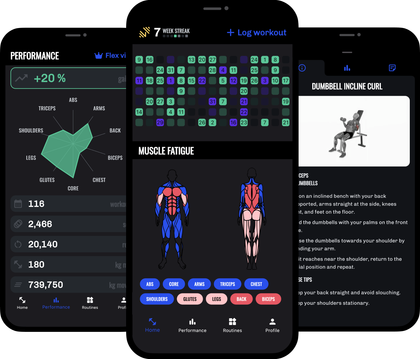
Track sets, reps, weight, rest times, RPE/RIR, and progress with Legend, on iOS and Android.
Platz-style training needs context. High-rep squats and long leg sessions can be effective, but they also create a lot of fatigue. If reps, loads, range of motion, and recovery are improving, the plan is working. If every leg day hurts the next week of training, the routine is too large.
The Tom Platz leg workout is a high-volume lower-body routine built around a simple order:
The unusual part is the rep range. Platz-style squatting is not only sets of 5 or 8. It often includes heavy work and then back-off sets that climb into 15, 20, 30, or more reps. That makes the session both a strength workout and a strength-endurance test, which is why RPE and RIR tracking matters more than bravado.
This does not mean every lifter should chase marathon squat sets. It means a leg routine can use different rep ranges for different reasons. Heavy sets build skill and load tolerance. Moderate sets build repeatable volume. Higher-rep sets teach control and effort under fatigue.
The practical filter is simple: the routine has to make the next few weeks better, not just make one workout memorable.
Platz’s signature exercises are mostly familiar leg-day tools taken seriously: squats, hack squats, extensions, curls, and calf work. If you need alternatives, use the exercise library to keep the same pattern instead of forcing one painful machine or stance.
Before jumping into the routines, it helps to understand why these exercises matter. Platz was famous for effort, but the exercise choices were not random. They covered quads, hamstrings, calves, chest, back, shoulders, and arms with movements that can be repeated and tracked.
The squat is the center of the Tom Platz workout. His best-known style was a high-bar, deep squat with an upright torso and a large range of motion. The point was not just to move the most weight. The point was to load the legs through a demanding movement pattern and then repeat that pattern with discipline.
For most lifters, the practical version is simple: choose a squat depth you can control, keep the torso position consistent, and progress only when the reps still look like the same lift.
Barbell Squat
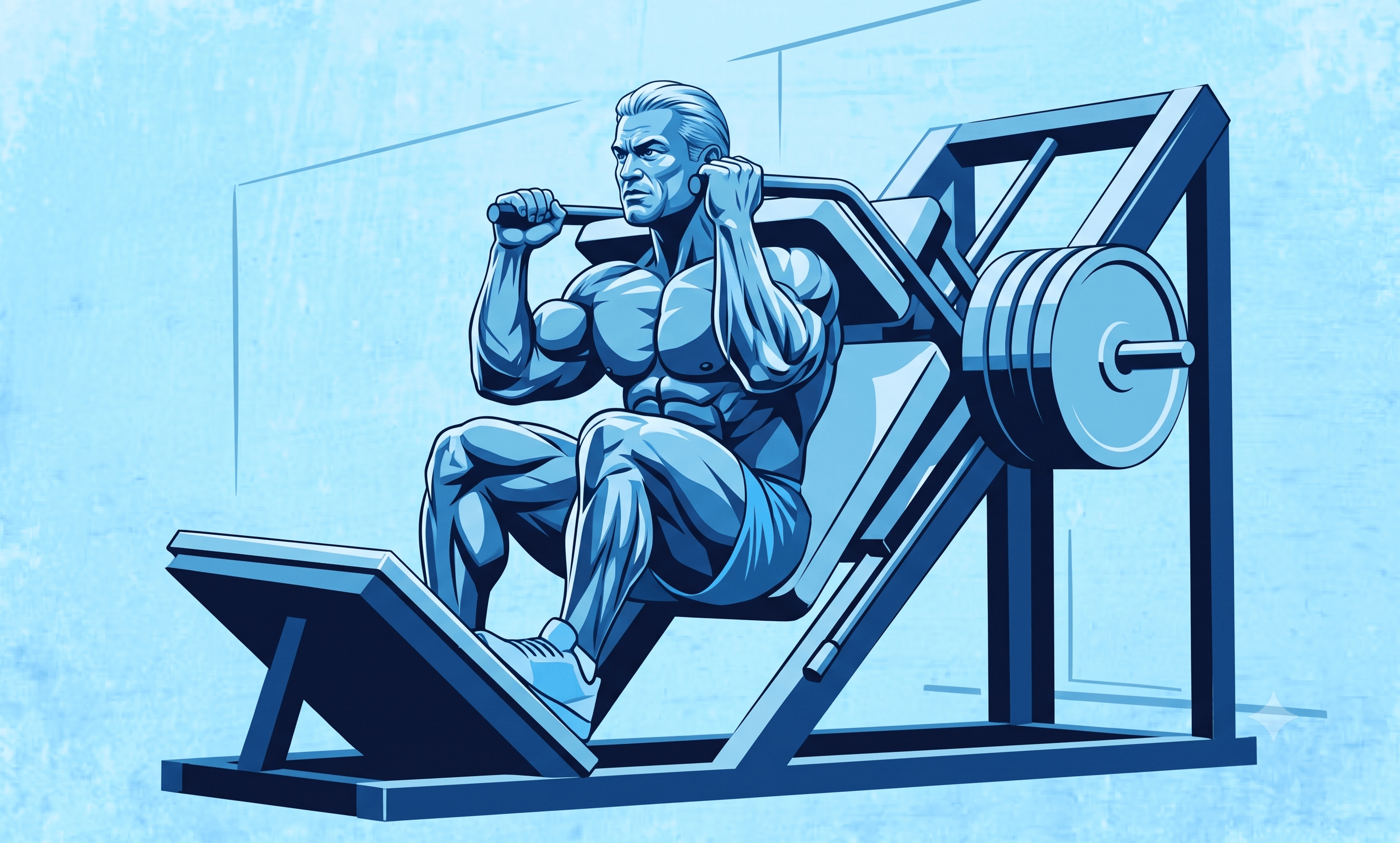
The hack squat lets you keep hammering the quads after free-weight squats without the same bracing and balance demand. Platz often used narrow or close stances to bias the quads and keep tension high.
Use this carefully. A narrow stance and deep knee bend can feel excellent for the quads, but it has to match your ankle, knee, and hip tolerance. If depth causes joint irritation, adjust stance, range of motion, or load.
Machine Hack Squat
Leg extensions are the direct quad isolation piece. In a Platz-inspired routine, they are not a throwaway finisher. They let you train knee extension hard after squats and hack squats have already created a lot of compound fatigue.
Keep them controlled. Pause briefly at the top, lower the weight with intent, and avoid turning the machine into a hip-rocking movement. If your knees dislike heavy extensions, use lighter load, higher reps, shorter range, or a different quad movement.
The hamstrings need direct work because squats alone do not cover every lower-body function equally. Lying leg curls train knee flexion and help balance the quad-heavy nature of the routine.
The goal is not to throw the pad upward. Curl with control, squeeze at the top, and lower slowly enough that the hamstrings stay loaded.
Machine Lying Leg Curl
Platz-style leg training usually includes both standing and seated calf work. Standing calf raises bias the gastrocnemius more strongly because the knee is straight. Seated calf raises train the calves with the knee bent and help cover the soleus.
Use a full stretch, pause the top position, and avoid bouncing through the bottom. Calves can handle repeated work, but the reps still need to be honest.
Barbell Standing Calf Raise
Platz was known for legs, but he still trained the upper body seriously. Incline dumbbell pressing fits the golden era style because it gives a long range of motion, trains the upper chest, and can be progressed without forcing every pressing session through a flat barbell bench press.
Use a controlled stretch, stable shoulder blades, and a pressing path that your shoulders tolerate.
Dumbbell Incline Bench Press
Back width keeps a leg-dominant physique from looking incomplete. Pull-ups and pulldowns train the lats directly and are easier to recover from than making every back session a heavy deadlift session.
If pull-ups are not ready yet, use pulldowns and track load, reps, and form. The target is clean progression, not loose reps.
Cable Lat Pull-Down
Rows give the upper back the thickness needed to balance wide lats and big legs. A cable row is easier to control and recover from. A T-bar row is heavier and more demanding.
Choose the version that lets you pull hard without turning every rep into lower-back extension.
Cable Seated Row
Shoulders and arms complete the split. A machine or barbell press covers heavier shoulder work. Lateral raises train the side delts. Curls and triceps extensions add direct arm volume.
The point is not to make the upper body routine as exhausting as the leg day. The point is to keep the whole physique progressing while leaving enough recovery for lower-body specialization.
Machine Shoulder Press
The pattern matters more than a perfect exercise list. Platz-style training rewards exercises that can be loaded, controlled through a large range of motion, and measured over time.
Start here if you want the Quadfather lesson without jumping straight into the highest-volume version.
Train 3 days per week at first. Keep at least one full rest day between sessions. Use controlled reps, stop most compound sets with 1-2 reps in reserve, and add volume only when your next session is not suffering.
| Exercise | Working Sets | Reps | Notes |
|---|---|---|---|
| Barbell Squat | 4 | 6-12 | Use one heavier top set, then controlled back-off sets |
| Machine Hack Squat | 3 | 10-15 | Keep the range of motion consistent |
| Leg Extension | 3 | 10-15 | Pause briefly at the top |
| Lying Leg Curl | 3 | 10-15 | Slow lowering phase |
| Standing Calf Raise | 3 | 10-20 | Full stretch and full contraction |
| Seated Calf Raise | 2 | 12-20 | Do not bounce through reps |
| Exercise | Working Sets | Reps | Notes |
|---|---|---|---|
| Dumbbell Incline Press | 3 | 8-12 | Use a controlled stretch |
| Dumbbell Fly or Cable Fly | 2 | 10-15 | Stop before shoulder position changes |
| Pull-Up or Lat Pulldown | 3 | 8-12 | Track clean reps |
| Cable Row or T-Bar Row | 3 | 8-12 | Pull with the back, not momentum |
| Chest Dip or Push-Up | 2 | 8-15 | Optional if recovery is good |
| Exercise | Working Sets | Reps | Notes |
|---|---|---|---|
| Military Press or Machine Shoulder Press | 3 | 8-12 | Use a pain-free pressing path |
| Dumbbell Lateral Raise | 3 | 12-20 | Stop before swinging |
| Rear Delt Raise or Face Pull | 2-3 | 12-20 | Balance pressing volume |
| Barbell Curl | 3 | 8-12 | Keep elbows steady |
| Triceps Extension or Pressdown | 3 | 10-15 | Keep elbows comfortable |
Run this for 4-6 weeks. If leg performance is improving and joints feel good, add one set to squats or hack squats before adding another leg day.
The classic Tom Platz leg workout is much more demanding. It is best treated as an advanced template or occasional specialization session, not a weekly requirement for most lifters.
| Exercise | Sets | Reps | Rest |
|---|---|---|---|
| Back Squat | 8-12 | 5-20 | 2-4 min |
| Machine Hack Squat | 4-5 | 10-15 | 90-120s |
| Leg Extension | 5-8 | 10-15 | 90-120s |
| Lying Leg Curl | 6-10 | 10-15 | 90-120s |
| Standing Calf Raise | 3-4 | 10-20 | 60-90s |
| Seated Calf Raise | 3-4 | 10-20 | 60-90s |
This session is intentionally large. If you try it, reduce the volume first and earn your way upward. You can also run it every other week while using a smaller leg day in between.
The 1992 Great American Squat-Off is part of why Platz remains tied to strength-endurance. In that event, he is widely remembered for squatting 525 pounds for 23 reps against Dr. Fred Hatfield. Hatfield was the stronger max-squat specialist in the contest, but Platz’s high-rep result became the bodybuilding legend.
Use that story carefully. It is not proof that every lifter should max out high-rep squats. It is a reminder that strength and muscular endurance are related but different qualities, and that high-rep technique breaks down fast if you have not built the base for it.
Platz is best known for legs, but the full routine also included chest, back, shoulders, arms, and rest. The exact split varied, but a common way to understand the structure is four training days followed by rest.
| Day | Focus | Main Idea |
|---|---|---|
| Day 1 | Chest and Back | Pressing and pulling volume, sometimes split across the day |
| Day 2 | Shoulders | Heavy pressing plus high-rep raises |
| Day 3 | Arms | Curls and triceps work with controlled volume |
| Day 4 | Legs | Squats, hack squats, extensions, curls, calves |
| Day 5 | Rest | Recovery, easy walking, mobility |
For modern lifters, this structure usually works better when Day 1 is a single session, not a double split. If legs are the priority, the rest of the week should support that priority instead of competing with it.
The easiest mistake is turning inspiration into punishment. Use these adjustments instead.
The practical three-day split gives you a leg-focused routine without overwhelming the rest of your week. Run it before trying the classic leg day.
You do not need five high-rep squat sets to learn from Platz. Use one back-off set of 12-20 reps after your heavier squat work, then track whether it improves.
If fatigue makes your squat depth, bracing, or knee control inconsistent, reduce sets. Do not keep the volume and let the movement fall apart.
Hack squats, leg extensions, and leg curls let you train the legs after free-weight work without needing the same balance and bracing. That is useful, but the joints still need to tolerate the movement.
If your next lower-body session is worse, your current leg day is too large. Soreness is not the goal. Repeatable progress is the goal.
Platz-style training needs more than effort. It needs a logbook.
Legend helps here because you can build the routine once, log every set, capture RPE/RIR, review exercise history, and see whether your squat, hack squat, and leg curl work are actually progressing.
You do not need to copy every old-school bodybuilding food habit to learn from the routine. The practical food lesson is simpler: high-volume leg training requires enough energy, enough protein, enough carbohydrate, and enough consistency to recover.
For most lifters, that means:
The International Society of Sports Nutrition position stand gives a broad protein range for exercising individuals, but the exact intake still depends on body size, training volume, diet preference, and goal. The useful habit is consistency.
The classic version is advanced. A smaller leg day done well for months will usually beat a giant leg day that ruins the rest of your week.
Deep squats are useful only when you can control the position. If your heels rise, your pelvis shifts, or your back position collapses, adjust the load or range.
High effort matters, but constant all-out sets are hard to recover from. Keep most work at RPE 7-9 and save the hardest sets for movements you can control safely.
The Quadfather routine is not only quads. Hamstrings and calves are part of the lower-body look and help keep the routine balanced.
Soreness can happen, especially with high-rep leg work, but it is not the scoreboard. Your logbook is the scoreboard.
The Tom Platz workout routine is a bodybuilding plan built around deep squats, high-rep leg work, hack squats, leg extensions, leg curls, calf raises, and upper-body training that keeps the physique balanced.
The classic version is not a beginner routine. Beginners should use a lower-volume leg day, learn squat technique, and build consistency before attempting advanced high-rep squat work.
Most lifters should start with one hard leg day per week. Advanced lifters may use a Platz-inspired specialization block, but the high-volume version often needs more recovery than a normal leg session.
Platz is associated with high-bar, deep squats, an upright torso, strong knee flexion, and high-rep back-off sets. The practical takeaway is controlled range of motion and repeatable technique under fatigue.
No. He trained his full body. His legs became his signature, but his routine also included chest, back, shoulders, arms, calves, and abs.
The exercises most associated with Platz-style training include barbell squats, hack squats, leg extensions, lying leg curls, standing calf raises, seated calf raises, incline dumbbell presses, pulldowns, rows, military presses, curls, and triceps extensions.
Not at first. Start with 3-4 working squat sets. Add sets only when your technique, recovery, and next-session performance are stable.
Use rep ranges. When you can complete all sets at the top of the range with consistent form and rest, add a small amount of weight. For high-rep squats, add reps before adding load.
Yes, but it requires substitutions. Use squats, Bulgarian split squats, heel-elevated goblet squats, Romanian deadlifts, sliding leg curls, and calf raises. Machines make the classic routine easier to load, but they are not mandatory.
Create the routine once, log every set, keep rest times consistent, record RPE or RIR, and review exercise history before adding more leg volume. If your squat or hack squat is not progressing, adjust recovery before adding exercises.
For almost everyone, no. It is a historical strength-endurance feat, not a normal training target. A better goal is improving your own controlled squat reps over time.
Tom Platz’s routine is inspiring because it made leg training deliberate. Deep squats, high-rep tolerance, controlled isolation, and serious recovery can teach a lot when they are scaled properly.
The smart way to use it is to start with the practical version, track every session, and add volume only when your performance proves you can recover from it.
Lift more.
See progress.
Get consistent.
Legend is the most intuitive workout tracker for iOS and Android.


Scan on iPhone


Scan on Android