Exercise Library
Back Exercises
Choose back exercises for your equipment and training goals, then build a session with rows, pulldowns, and appropriate hip-hinge work.
Choose exercises · Sample workout · Video demonstrations
Choose back exercises
Start with a row and a vertical pull if your equipment allows. Rows bring the load toward your torso; pulldowns and pull-ups bring your arms down from overhead. Hip hinges such as Romanian deadlifts ask your back to hold position while your hips move. They serve a different role from a row, so do not count every exercise labelled “back” as interchangeable.
| Your setup or goal | Exercise to consider | How to use it |
|---|---|---|
| Cable machine, horizontal pull | Cable seated row | Set up consistently and row without rocking your torso to move the stack |
| Cable machine, vertical pull | Lat pulldown | Choose a load that allows a controlled pull and return |
| Pull-up bar | Pull-up | Use suitable assistance if you cannot yet complete controlled repetitions |
| Barbell, horizontal pull | Bent-over row | Useful when you can maintain a steady hinged position |
| Dumbbells at home | Dumbbell row variations | Choose a supported row with a bench, or a bent-over row without one |
| Hip-hinge work | Romanian deadlift | Plan alongside your leg training; it does not replace your pulling exercises |
Which muscles are you training?
Your lats contribute to moving the upper arm, while the trapezius and rhomboids help control the shoulder blades. The spinal erectors help support your trunk. Most rows and pulls involve several muscles, including your arms; there is no need to find one exercise that perfectly isolates every part of the back.
If holding a bent-over position becomes the limiting factor, consider a supported dumbbell row or a seated cable row. A substitution should help you perform the movement consistently. It is not a way to train through persistent back pain.
Sample back workout
Use this as a sample pulling session within a balanced weekly program. It is not a complete whole-body plan or an extra session to stack onto a program that already includes equivalent work. Perform lighter preparation sets before the working sets below.
| Exercise | Sets | Reps | Rest |
|---|---|---|---|
| Cable lat pulldown | 2 | 8–12 | 2 min |
| Cable seated row | 2 | 8–12 | 2 min |
| Optional Romanian deadlift | 2 | 8–10 | 2–3 min |
Leave out the Romanian deadlift if your leg or full-body sessions already cover hip hinges. If you include it, place it earlier in the session while you can maintain your technique. Start with a load that leaves about two or three controlled repetitions available, and take longer rests when needed.
For a dumbbell-only setup, use the beginner or intermediate back routines. They provide a different equipment option; you do not need to perform both programs.
How often, and how do you progress?
ACSM’s current guidance recommends training the major muscle groups at least twice weekly. Count the pulling you already do in other sessions when deciding where this workout fits. Two non-consecutive pulling sessions are one possible arrangement, with sets adjusted to your total workload.
Record the load and repetitions. For a target of 2 × 8–12, build toward two controlled sets of 12 before trying a small weight increase. Keep the equipment and technique consistent when comparing sessions. If the heavier load prevents you reaching the lower end, use the earlier load again.
Fit back training into your week
Use our three-day workout guide to choose full-body, push/pull/legs, or upper/lower sessions. For more help choosing a load, see sets, reps, and weight.
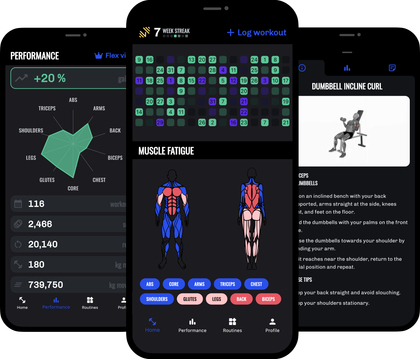
In Legend, create a custom routine with the exercises you chose. Add working sets, use notes for repetition ranges and equipment settings, and log the repetitions and weight you complete. These examples can be entered manually in the app.
Back exercise video library
Choose an exercise for its demonstration, equipment, and step-by-step instructions.

Barbell Bent-Over Row
The barbell bent-over row is an effective compound exercise that targets the muscles of the back, including the lats, traps, and rhomboids. It also engages the biceps, forearms, and core muscles to stabilize the body during the movement.

Barbell Deadlift
The barbell deadlift is a compound exercise that targets the muscles of the back, legs, and core. It is an effective strength-building exercise that can help improve overall muscle mass and power.

Barbell Good Morning
The barbell good morning is an exercise that targets the lower back, hamstrings, and glutes. It is performed by hinging at the hips to lower the barbell towards the floor while keeping your back straight and core engaged. This exercise helps to strengthen the posterior chain and improve hip mobility.

Barbell Romanian Deadlift
The barbell Romanian deadlift is a compound exercise that targets the hamstrings, glutes, and lower back. It is performed by hinging at the hips to lower the barbell towards the floor while keeping the back straight and core engaged.

Cable Lat Pull-Down
The cable lat pull-down is an exercise that targets the latissimus dorsi, or lats, which are the large muscles of the back. It also engages the biceps, rhomboids, and rear deltoids to assist in the movement.

Cable Seated Row
The cable seated row is an exercise that targets the muscles of the upper back, including the latissimus dorsi, rhomboids, and trapezius. It also engages the biceps and forearms as secondary muscles. This exercise helps improve back strength, posture, and stability.

Dumbbell Pull-Over
The dumbbell pull-over is an exercise that targets the back, chest, and triceps. It is performed by lying on a bench with a dumbbell held overhead and lowering it behind the head while keeping the arms straight.

Landmine Row
The landmine row is a compound exercise that targets the muscles of the upper back, including the latissimus dorsi, rhomboids, and trapezius. It also engages the biceps and forearms as secondary muscles. This exercise helps improve upper body strength and muscle definition.

Pull-Up
The pull-up is a compound exercise that targets the back, biceps, and forearms. It involves pulling your body weight up towards a bar using an overhand grip.
Build your routines from 1500+ exercises on Legend
Legend is the most intuitive workout tracker for iOS and Android.


Scan on iPhone


Scan on Android